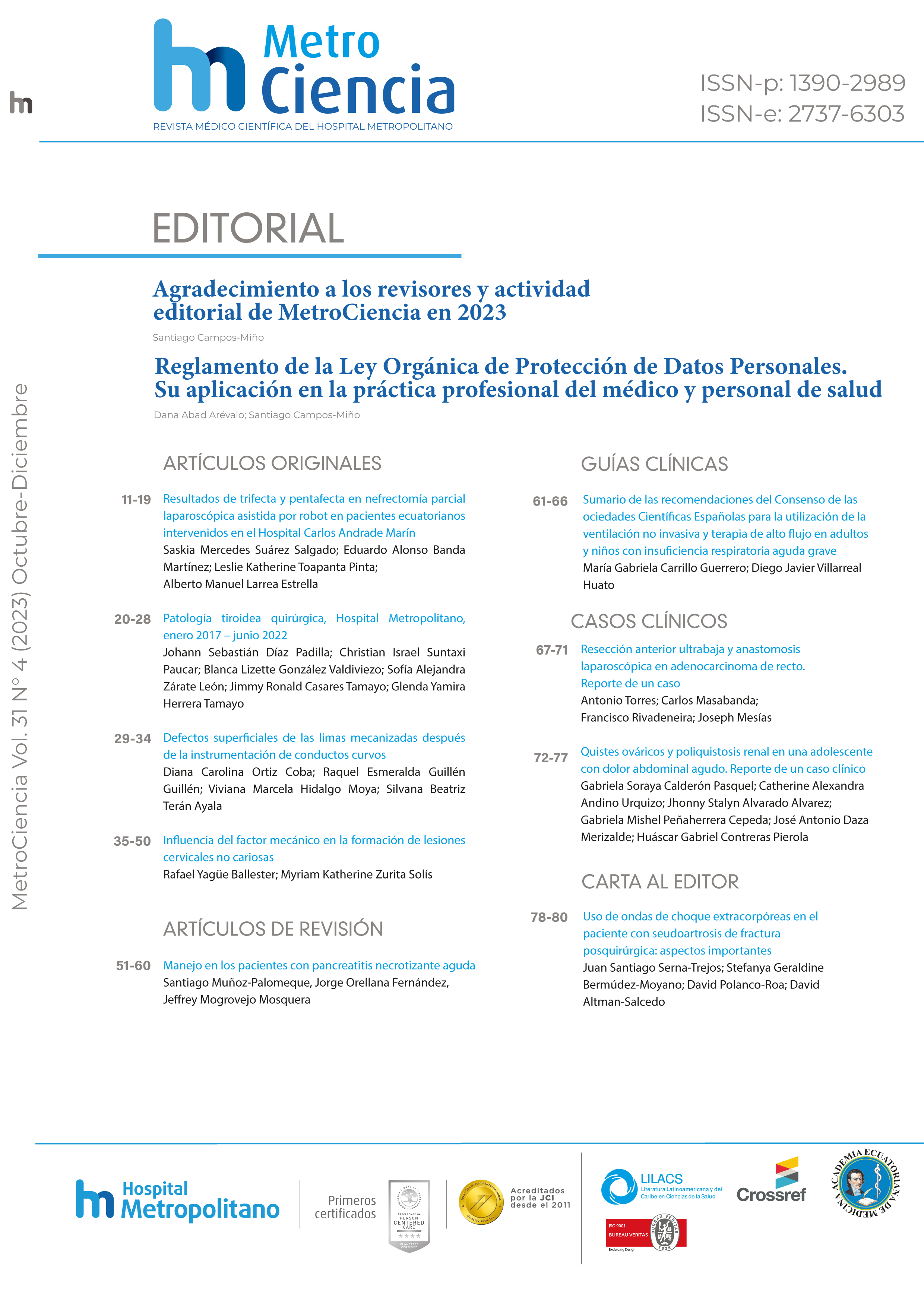
Management in patients with acute necrotizing pancreatitis
DOI:
https://doi.org/10.47464/MetroCiencia/vol31/4/2023/51-60Keywords:
Pancreatitis Acute Necrotizing, Surgical Procedures Operative, TherapeuticsAbstract
Introduction: Necrotizing pancreatitis is a complication of acute pancreatitis in 12% to 25% of cases. The present analysis sought to identify the most effective and beneficial procedures at present for the management of this complication. Methodology: A systematic literature review was carried out in the “PubMed”, “Google Scholar”, “Cochrane” and “MedScape” databases, selecting articles published between 2015 and 2017, retrospective, performed in patients with necrotizing pancreatitis. Results: 8 studies of the 35 finally reviewed were included. 65.12% of cases suggest that should be initiated with a minimally invasive intervention before resorting to open necrosectomy; 55.9% of the cases coincide with the existence of greater advantages regarding the "step-up approach"; and in 27.67%, it is evidenced that "four-step approach" is effective and reduced risks and complications compared to other "step-up" strategies. In 9.22% of the cases, open necrosectomy had greater complications than the minimally invasive procedure, coinciding with the fact that in 30.81% of the cases, Marshall's score, multiorgan dysfunction syndrome, preoperative respiratory infection, sepsis, preoperative systemic inflammatory response syndrome and increased levels of C-reactive protein, are associated with postoperative complications. Conclusions: For the management of necrotizing pancreatitis, it should be initiated in the first phase with conventional treatment and specific antibiotics in case of infection. In the second phase, if the patient becomes complicated, the step-up approach will be performed (four step approach). If it fails, open necrosectomy with closed packing will be used, always considering the possible complications of this procedure.
Downloads
References
Luján M, Peñuelas Ó, Cinesi Gómez C, et al. Summary of recommendations and key points of the consensus of Spanish scientific societies (SEPAR, SEMICYUC, SEMES; SECIP, SENEO, SEDAR, SENP) on the use of non-invasive ventilation and high-flow oxygen therapy with nasal cannulas in adult, pediatric, and neonatal patients with severe acute respiratory failure. Sumario de las recomendaciones y puntos clave del Consenso de las Sociedades Científicas Españolas (SEPAR, SEMICYUC, SEMES; SECIP, SENeo, SEDAR, SENP) para la utilización de la ventilación no invasiva y terapia de alto flujo con cánulas nasales en el paciente adulto, pediátrico y neonatal con insuficiencia respiratoria aguda grave. Med Intensiva (Engl Ed). 2021;45(5):298-312. doi:10.1016/j.medin.2020.08.016
Pisani L, Corcione N, Nava S. Management of acute hypercapnic respiratory failure. Curr Opin CritCare.2016;22:45---52,https://doi.org/10.1097/MCC. 0000000000000269.
Cinesi-Gómez C, García-García P, López-Pelayo I, Giménez JI, González-Torres LM, Bernal-Morell E. Correlation between oxyhaemoglobin saturation by pulse oximetry and partial pressure of oxygen in patients with acute respiratory failure. Rev Clin Esp. 2017;217:522---5.
Olivieri C, Carenzo L, Vignazia GL, Campanini M, Pirisi M, Della Corte F, et al. Does noninvasive ventilation delivery in the ward provide early effective ventilation? Respir Care. 2015;60:6-11, https://doi.org/10.4187/respcare.03294.
Kollef MH. Non-invasive ventilation for chronic obstructive pulmonary disease. Lancet. 2000;356:956---7, https://doi.org/10.1016/S0140-6736(00)02708-2.
González Barcala FJ, Zamarrón Sanz C, Salgueiro Rodríguez M, Rodríguez Suárez JR. Ventilación no invasiva en pacientes con enfermedad pulmonar obstructiva crónica e insuficiencia respiratoria aguda hipercápnica en una sala de hospitalización convencional. Anales de Medicina Interna. 2004;21:13---9.
Barbé F, Togores B, Rubí M, Pons S, Maimó A, Agustí AG. Noninvasive ventilatory support does not facilitate recovery from acute respiratory failure in chronic obstructive pulmonary disease. Eur Respir J. 1996;9:1240---5.
Carrillo A, Gonzalez-Diaz G, Ferrer M, Martinez-Quintana ME, Lopez-Martinez A, Llamas N, et al. Non-invasive ventilation in community-acquired pneumonia and severe acute respiratory failure. Intensive Care Med. 2012;38:458---66, https://doi.org/10.1007/s00134-012-2475-6.
Weng C-L, Zhao Y-T, Liu Q-H, Fu C-J, Sun F, Ma Y-L, et al. Meta-analysis: Noninvasive ventilation in acute cardiogenic pulmonary edema. Ann Intern Med. 2010;152:590---600, https://doi.org/10.7326/0003-4819-152-9-201005040-00009.
Wilson ME, Majzoub AM, Dobler CC, Curtis JR, Nayfeh T, Thorsteinsdottir B, et al. Noninvasive Ventilation in Patients With DoNot-Intubate and Comfort-Measures-Only Orders: A Systematic Review and Meta-Analysis. Crit Care Med. 2018;46:1209---16 https://doi.org/10.1097/CCM. 0000000000003082.
Tong S, Gower J, Morgan A, Gadbois K, Wisbach G. Noninvasive positive pressure ventilation in the immediate post-bariatric surgery care of patients with obstructive sleep apnea: a systematic review. Surg Obes Relat Dis. 2017;13:1227---33, http://dx.doi.org/10.1016/j.soard.2017.02.009.
Stéphan F, Barrucand B, Petit P, Rézaiguia-Delclaux S, Médard A, Delannoy B, et al. High-Flow Nasal Oxygen vs Noninvasive Positive Airway Pressure in Hypoxemic Patients After Cardiothoracic Surgery: A Randomized Clinical Trial. JAMA. 2015;313:2331---9, http://dx.doi.org/10.1001/jama.2015.5213.
Ducros L, Logeart D, Vicaut E, Henry P, Plaisance P, Collet J-P, et al. CPAP for acute cardiogenic pulmonary oedema from out-of-hospital to cardiac intensive care unit: a randomised multicentre study. Intensive Care Med. 2011;37:1501---9, https://doi.org/10.1007/s00134-011-2311-4.
Luo F, Annane D, Orlikowski D, He L, Yang M, Zhou M, et al. Invasive versus non-invasive ventilation for acute respiratory failure in neuromuscular disease and chest wall disorders. Cochrane Database Syst Rev. 2017;12:CD008380, https://doi.org/10.1002/14651858.CD008380.pub2.
Lim WJ, Mohammed Akram R, Carson KV, Mysore S, Labiszewski NA, Wedzicha JA, et al. Non-invasive positive pressure ventilation for treatment of respiratory failure due to severe acute exacerbations of asthma. Cochrane Database Syst Rev. 2012;12:CD004360, https://doi.org/10.1002/14651858.CD004360.pub4.
Belenguer-Muncharaz A, Reig-Valero R, Altaba-Tena S, Casero-Roig P, Ferrándiz-Sellés A. [Noninvasive mechanical ventilation in severe pneumonia due to H1N1 virus]. Med Intensiva.2011;35:470-7, http://dx.doi.org/10.1016/j.medin.2011.04.001.
Masclans JR, Pérez M, Almirall J, Lorente L, Marqués A, Socias L, et al. Early non-invasive ventilation treatment for severe influenza pneumonia. Clin Microbiol Infect. 2013;19:249-56, https://doi.org/10.1111/j.1469-0691.2012.03797.x.
Stefan MS, Priya A, Pekow PS, Lagu T, Steingrub JS, Hill NS, et al. The comparative effectiveness of noninvasive and invasive ventilation in patients with pneumonia. J Crit Care. 2018;43:190---6, http://dx.doi.org/10.1016/j.jcrc.2017.05.023.
Ferguson ND, Fan E, Camporota L, Antonelli M, Anzueto A, Beale R, et al. The Berlin definition of ARDS: an expanded rationale, justification, and supplementary material. Intensive Care Med. 2012;38:1573---82, https://doi.org/10.1007/s00134- 012-2682-1.
Curtis JR, Cook DJ, Sinuff T, White DB, Hill N, Keenan SP, et al. Noninvasive positive pressure ventilation in critical palliative care settings: understanding the goals of therapy. Crit Care Med.2007;35:932---9,https://doi.org/10.1097/01.CCM.0000256725. 73993.74.
Nava S, Ferrer M, Esquinas A, Scala R, Groff P, Cosentini R, et al. Palliative use of non-invasive ventilation in end-of-life patients with solid tumours: a randomised feasibility trial. Lancet Oncol. 2013;14:219---27,https://doi.org/10.1016/S1470–2045(13) 70009-3.
Rochwerg B, Brochard L, Elliott MW, Hess D, Hill NS, Nava S, et al. Official ERS/ATS clinical practice guidelines: noninvasive ventilation for acute respiratory failure. Eur Respir J. 2017:50, https://doi.org/10.1183/13993003.02426-2016.
Ouellette DR, Patel S, Girard TD, Morris PE, Schmidt GA, Truwit JD, et al. Liberation From Mechanical Ventilation in Critically Ill Adults: An Official American College of Chest Physicians/American Thoracic Society Clinical Practice Guideline: Inspiratory Pressure Augmentation During Spontaneous Breathing Trials Protocols Minimizing Sedation, and Noninvasive Ventilation Immediately After Extubation. Chest. 2017;151:166-80, http://dx.doi.org/10.1016/j.chest.2016.10.036
Frat J-P, Thille AW, Mercat A, Girault C, Ragot S, Perbet S, et al. High-flow oxygen through nasal cannula in acute hypoxemic respiratory failure. N Engl J Med. 2015;372:2185-96, http://dx.doi.org/10.1056/NEJMoa1503326.
Frat J-P, Ragot S, Girault C, Perbet S, Prat G, Boulain T, et al. Effect of non-invasive oxygenation strategies in immunocompromised patients with severe acute respiratory failure: a post-hoc analysis of a randomised trial. Lancet Respir Med. 2016;4:646-52, https://doi.org/10.1016/S2213- 2600(16)30093-5.
Russotto V, Cortegiani A, Raineri SM, Gregoretti C, Giarratano A. Respiratory support techniques to avoid desaturation in critically ill patients requiring endotracheal intubation: A systematic review and meta-analysis. J Crit Care. 2017;41:98-106, http://dx.doi.org/10.1016/j.jcrc.2017.05.003.
Baillard C, Fosse J-P, Sebbane M, Chanques G, Vincent F, Courouble P, et al. Noninvasive ventilation improves preoxygenation before intubation of hypoxic patients. Am J Respir Crit Care Med. 2006;174:171-7, https://doi.org/10.1164/rccm.200509- 1507OC.
Parke R, McGuinness S, Dixon R, Jull A. Open-label, phase II study of routine high-flow nasal oxygen therapy in cardiac surgical patients. Br J Anaesth. 2013;111:925-31, http://dx.doi.org/10.1093/bja/aet262.
British Thoracic Society Standards of Care Committee. Noninvasive ventilation in acute respiratory failure. Thorax. 2002;57:192-211, https://doi.org/10.1136/thorax. 57.3.192.
Roca O, Hernández G, Díaz-Lobato S, Carratalá JM, Gutiérrez RM, Masclans JR, et al. Current evidence for the effectiveness of heated and humidified high flow nasal cannula supportive therapy in adult patients with respiratory failure. Crit Care. 2016;20:109, https://doi.org/10.1186/s13054-016-1263-z.
Roca O, Caralt B, Messika J, Samper M, Sztrymf B, Hernández G, et al. An Index Combining Respiratory Rate and Oxygenation to Predict Outcome of Nasal High Flow Therapy. Am J Respir Crit Care Med. 2018, https://doi.org/10.1164/rccm.201803- 0589OC
Downloads
Published
Issue
Section
License
Copyright (c) 2023 Santiago Andrés Muñoz Palomeque, Jorge Orellana Fernández, Jeffrey Mogrovejo Mosquera

This work is licensed under a Creative Commons Attribution 4.0 International License.
How to Cite